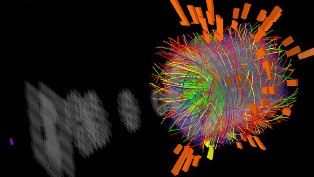


CANADA: The European Organization for Nuclear Research (CERN) announced that its Large Hadron Collider (LHC) has collided lead ions at an energy level nearly twice as high as that of any previous experiments with the particle accelerator. The LHC is the most powerful particle collider in the world to date, and it measures 17 miles in length.
On Nov. 17, the LHC fired two counter-circulating beams of lead nuclei at each other, and on Nov. 25, stable beams were declared. The collisions were recorded by ALICE, which stands for A Large Ion Collider Experiment, a heavy-ion detector on the ring of the LHC. The latest experiment set a new record for the highest energy collisions of heavy atomic nuclei.
Researchers from the University of Copenhagen, who are part of CERN’s study, explained that the Universe was once made up of a dense, hot mix of fundamental particles called gluons and quarks. This state of the Universe is known as the quark-gluon-plasma. And then the Big Bang took place. A millionth of a second later, the QGP started fusing together into the neutrons and protons of atomic nuclei, forming bulk matter and other particles. Researchers believe that the fusion was coaxed by a massive nuclear force that enabled the quarks to bind together.
The goal of the CERN study is to recreate the high temperature similar to that at the birth of the Universe when gluons and quarks were in a liquid-like state. CERN does this by colliding lead ions together. Through the conversion of the collision’s kinetic energy into matter, the researchers can produce tiny volumes of antiquarks and quarks at temperatures reaching several trillion degrees.

Karachi Port sets 138-year cargo handling record
KARACHI: Pakistan's maritime sector has achieved a major milestone as Karachi Port set a new record in its 138-year history...