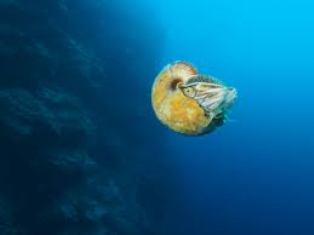


MEXICO: University of Washington biologist Peter Ward has spotted extremely rare Allonautilus scrobiculatus species of nautilus near Papua New Guinea. Ward and his fellow scientist had discovered the rare species near Ndrova Island in Papua New Guinea. After three decades, he has spotted nautilus and has shared some amazing photos.
In 1984, Ward and his team member Saunders collected several Allonautilus scrobiculatus specimens for analysis and realized that their gills, jaws, shell shape and male reproductive structures differ significantly from other nautilus species.
Ward added that the species faces danger due to over fishing in some regions. The species has thick, hairy, slimy covering on its shell. They are expert scavengers. Ward and his team members set up bait with chicken meat, around 1,300 feet under the surface. The bait was monitored with cameras for 12 hours. Ward said that they were successful in recording some amazing footage.
As nautiluses are not able to face the heat, they were taken to the surface in chilled water. The scientists collected shell and mucous samples along with small tissue for further research. They were released back in the water around 600 feet deep after the samples were taken.
Ward, who holds appointments at the UW in both the Department of Biology and the Department of Earth and Space Sciences, said, “Before this, two humans had seen Allonautilus scrobiculatus. My colleague Bruce Saunders from Bryn Mawr College found Allonautilus first, and I saw them a few weeks later.”
“Just like submarines, they have ‘fail depths’ where they’ll die if they go too deep, and surface waters are so warm that they usually can’t go up there. Water about 2,600 feet deep is going to isolate them.” added Ward.
The research project has been supported by National Geographic, the National Science Foundation’s Division of Polar Programs and the Tiffany & Co. Foundation. Ward worked with Richard Hamilton and Manuai Matawai from the Nature Conservancy and Greg Barord from the City University of New York during the current season.

Karachi Port sets 138-year cargo handling record
KARACHI: Pakistan's maritime sector has achieved a major milestone as Karachi Port set a new record in its 138-year history...