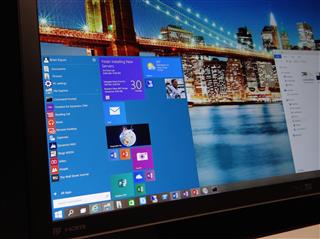
NEW YORK: The launch of Windows 10 is widely expected tomorrow, and The INQUIRER team has been looking back at Windows past and coming up with the features we remember, with varying degrees of fondness, from old editions.
We’ve already told you what we are definitely expecting, but could any of these make a reappearance tomorrow?
You might also like


- Start menu
OK, so we know this is coming back. But seriously, Microsoft, What were you thinking in getting rid of it? What? What? We know pretty much what to expect from the new Start Menu, but could we get curveballed? Watch this space.
- That green meadow background
Officially called ‘Bliss’, it was taken by Charles O’Rear and depicts a meadow in Sonoma, California. It was bought by Microsoft and is said to be the second most expensive stock image in the world.
- The XP start-up chime
There’s no name for the shade of red that you go after your computer, which has been left on full volume, suddenly blares out Microsoft’s most famous sonic logo and gives the company secretary a coronary. Composed by Bill Brown, it was the first to be based on an orchestral recording.
- Minesweeper
Along with Solitaire, these two games are pivotal to the success of the whole Windows franchise. Most temps, secretaries and security guards in the nineties were largely paid for playing them.
- Clippy
Technically an Office feature but let’s face it, in this world of virtual assistants Clippy will always hold a special place in our hearts. And do you really think Cortana is going to bounce onto the screen and offer to help you compose a letter? Didn’t think so.
- Windows Experience Index
The Windows equivalent of Top Trumps. A simple benchmarking tool that worked on the basis that your computer was only as strong as its weakest capabilities. You could compare your scores with others’ to find out who had the best laptop.
- Messenger
Yeah, yeah. Skype. Whatevs. Messenger, later MSN Messenger and Windows Live Messenger, is where it was at. Emoticons in the pre-emoji age and so many features that were ahead of their time, like handwriting support.
- DVD support
Because apparently we no longer need this out of the box. That pile of 200 DVD movies you haven’t got round to (ahem) backing up yet? Pshaw. Why would you want your computer to be able to store them? Music Magpie must hate this.
- Clip Art
Ditched last year, Clip Art was the reassuring backbone of many a church fête poster and poorly produced corporate handbook. Full of metaphorical and allegorical imagery, Microsoft now directs you to Bing Images for this. Hurrumph. Find me a good picture of some people in suits randomly climbing the axis of a graph on there. Didn’t think so.
- Active desktop
Yes, OK, it absolutely killed your CPU but the idea of having an mpeg running as your wallpaper seemed absolutely awesome in 2006. Surely, if you can do it on a phone now, we’ve progressed enough that it’ll work on a desktop screen?
So that’s our 10. Honourable mentions for Desktop Gadgets, customisable task bars, the Aero Glass theme, and Outlook Express. But we put it to you. If you wanted Microsoft to bring back something from Windows of old to Windows 10, what would it be?
However, we’re looking for features – if anyone suggests that we just bring back Windows XP, The INQUIRER will be round to slap you across the face with an Arbroath Smokie.
We’ll be live with cups of coffee in hand to cover events as they unfold tomorrow, and will bring you all the news as it breaks.
Microsoft Corp. is speculated to be bringing Android apps to Windows mobile platforms when it launches Windows 10 on Wednesday, according to ZDNet, effectively closing the app gap between Android/iOS and Windows devices.
As of September 2014, Microsoft has over 527,000 Metro-Style apps in both the Windows Store and Windows Phone store, and of these applications, approximately 340,000 are designed for Windows Phone devices. Compare this number to the 1.3 million apps in the Apple app store, or the 1.3 million apps in the Google Play Store, and Windows Phone devices begin to seem very limited.
While the apps situation has improved significantly in the Windows Phone ecosystem over the last year or so, the lack of app support is a strong deterrent for the average consumer and in turn, also to developers who are considering creating or porting over existing apps to Windows devices. Many popular applications have only just recently come to Windows Phone devices in the last year.
Software like Bluestacks, a free program allowing Windows and Mac users to run Android applications, already exists, so bringing Android apps to Windows in an official capacity is likely very possible. Although the application does have limitations related to Android’s native ARM code and the common x86 chips powering Windows computers and devices, experts feel there are likely a number of workarounds for this technical problem.
BlackBerry Ltd. tried a similar approach to expanding their platform’s struggling app ecosystem by bringing Android applications to their platform, but ended up seeing mixed results, with many apps crashing or not working.
But with Microsoft currently only controlling roughly 2.7% of the smartphone market, the company needs to take drastic measures to win back customer support. The benefit of bringing Android apps to Windows phone devices could be significant, fleshing out Microsoft’s mobile ecosystem and also preventing current users from abandoning Microsoft’s operating system, as well as potentially attracting new Windows Phone users.
Windows 10 is also rumoured to be the first step towards the company creating a unified, single operating system and app store. The popular start menu from past Windows operating systems is also set to make a return.
Reports that Microsoft was experimenting with plans to bring Android apps to Windows devices surfaced around this time last year. Microsoft is set to hold a press conference on Jan. 21 in which the company is expected to reveal Windows 10.