DOHA: The global oil demand is expected to grow by 1.25 million barrels per day (mbpd) to average 94.23 mbpd in 2016. Speaking at the international conference on the impact of oil prices, Dr Ali Al Amari, Counselor for Economics and Finance, Prime Minister Office, Qatar said that the Middle East oil demand is likely to increase by 0.18 mbpd in 2016.
Prime Minister and Interior Minister H E Sheikh Abdullah bin Nasser bin Khalifa Al Thani opened the 15th International Conference of the Middle East Economic Association (MEEA), hosted by Doha Institute for Graduate Studies. Minister of Economy and Commerce, H E Sheikh Ahmed bin Jassim Al Thani was also present.
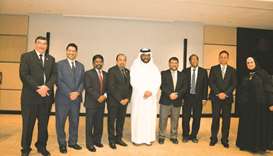
The three-day conference on ‘The Impact of Oil Price Changes on the Economic Growth and Development in the MENA Countries’ is being held at Ritz-Carlton Hotel.
Dr Al Amari said that ‘OECD Americas’ oil demand is projected to grow by 0.29 mbpd in 2016 compared with the previous year. Chinese oil demand in 2016 is projected to increase by 0.29 mbpd compare to 0.33 mbpd in 2015.
He said the oil market has undergone some substantial changes since the last three years. Prices fell from above $80 per barrel then to the mid-40 per barrel range in January 2016.
Throwing light on supply side, he said that total non-Opec (Organisation of the Petroleum Exporting Countries) oil supply in 2015 was revised up by 110 thousand barrels per day (tbpd) to average 57.09 mbpd. Despite weaker oil prices, non-Opec supply in the first quarter of 2016 was a higher-than-expected by 0.41 mbpd to average 56.94 mbpd. Middle East oil supply declined by 80 tbpd y-o-y to average 1.26 mbpd in 2015. The total decline for 2016 is expected to be 50 tbpd, revised down by 10 tbpd due to ongoing geopolitical conflicts. Total oil supply is expected to fall to 1.22 mbpd in 2016, he added.
Opec’s oil exports represent about 56 percent of the total world crude oil. According to current estimates, more than 80 percent of the world’s proven oil reserves are located in Opec Member Countries, with the bulk of Opec oil reserves in the Middle East, amounting to around 66 percent of the Opec total.
James Robinson, Professor, Harris School of Public Policy Studies, University of Chicago (USA) delivered presentation on ‘Why Nations Fail: Implications for Oil Producing Economies’.
He said that Oil rents in the Gulf have allowed for both for state formation and for massive investment in socially desirable things such as education, infrastructure, health.
“Oil wealth can be enormously valuable to society. Sitting in Qatar, you can see the fruits of it. The oil wealth has had incredible transformative effect on the society and welfare of the citizens. It has allowed to institutionalise itself and provide enormous amounts of services and public goods to citizens,” said Robinson.
He added that having inclusive political institutions seems to be the best recipe for utilising oil wealth in the interests of society.
He said that MENA (Middle East and North Africa) is a very diverse region, but the challenge for many of the large oil and gas producers is how to build inclusive institutions while respecting their individual heritages. Their success so far is based on this modernisation of tradition and it’s a good model for the future.