FAISALABAD: The Federal Board of Revenue (FBR) is undertaking extensive reforms and structural changes aimed at completely eliminating tax evasion and the concept of non-filers, a senior official said during an awareness seminar at the Faisalabad Chamber of Commerce and Industry.
Secretary Tax Education, Muhammad Muti-ur-Rehman Mumtaz, stated that the Tax Education and Facilitation Wing is playing a central role in promoting a tax-compliant culture across the country. He noted that the reform journey began two years ago, with broad consultations involving key stakeholders to design effective and practical tax policies.

He explained that accountability within FBR has been strengthened, while discretionary powers have largely been eliminated through digitalization. Advanced automated systems have been introduced to curb tax evasion and ensure transparency.
As a result, monitoring of sectors such as sugar mills has generated an additional Rs103 billion in sales tax revenue within two months, with similar gains observed in textile, steel, beverage, and cement industries. He emphasized that these improvements have faced minimal resistance due to reliance on automated, data-driven systems without human interference.
Mumtaz further revealed that 1.7 million new taxpayers have been added to the tax net. Instead of direct enforcement against non-filers, the government has implemented measures making foreign travel and property transactions significantly more difficult and costly for them, encouraging voluntary compliance.
He added that the tax policy division has now been separated, and each citizen’s CNIC serves as their tax identification number, integrating records of financial transactions, including detection of fake accounts. Referring to the Point of Sale (POS) system, he said service providers are responsible for collecting taxes on behalf of the government, with strict action taken against non-compliant entities.
Speaking at the event, Farooq Yousaf Sheikh highlighted the importance of collaboration between the private sector and government institutions, describing them as two essential components for economic stability. He stressed the need for unity among trade bodies and noted that joint recommendations prepared by stakeholders have already been submitted to the finance ministry.
He also pointed out that tax compliance is a global norm, urging businesses and individuals in Pakistan to adopt voluntary tax payment practices while acknowledging the need for further improvements in the system.
Meanwhile, Abdul Rehman Sheikh shared that FBR has introduced a reward scheme for individuals who report tax evasion. He disclosed that 3.3 million potential taxpayers have been identified through electricity consumption data, with initial notices issued to 100,000 individuals.
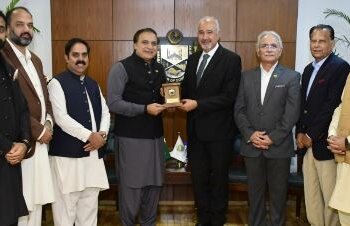
The seminar concluded with an interactive question-and-answer session attended by key business representatives, followed by a ceremony marking the chamber’s Golden Jubilee celebrations, where commemorative shields and documents containing budget proposals were presented to the FBR delegation.