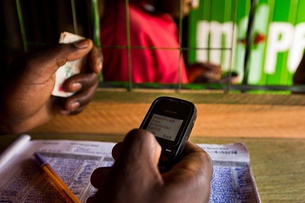
GENEVA: Will a financial revolution follow the Jasmine uprising in Tunisia? A Swiss start-up, Monetas, is proposing just that, saying a new mobile phone payment technology will transform people’s lives there.
Mobile payments are nothing new; more than half of Kenya’s population currently uses the M-Pesa service, for instance. But Monetas claims to have gone a step further by utilising technology akin to blockchain to dramatically reduce costs and enable cross-border transactions.


The Tunisian National Post invited the Zug-based firm to pilot its technology in October in conjunction with local firm DigitUs. Once all integrations with the existing e-dinar system are finalised, the Monetas system will be ready to roll out live, first targeting retailers before reaching out to the general population.
“What we see is that countries like Tunisia, which went through a period of change during the Jasmine Revolution, are rethinking some basic principles in their markets,” Monetas Chief Marketing Officer Vitus Ammann told swissinfo.ch. “They see digitisation as a very important driver of financial inclusion.”
This sentiment was echoed by Tunisian Post chief executive M Moez Chakchouk who heralded Monetas as a “key component” in the drive to “power the digital economy” which is at the “heart of financial inclusion efforts in Tunisia”.
More than two billion people globally are disconnected from formal financial services, most of them in poorer countries, according to the World Bank. In 2014, just over a quarter of Tunisian adults held a bank or post office account, and many of these accounts had been inactive for two years.
In sub-Saharan Africa, financial technology (fintech) is driving increased access to banking services. The World Bank estimates that only 34% of adults in this region had access to financial services in 2014, but this is up from 24% in 2011. This is largely because 12% of adults have payment services on their mobile phones, compared to a global average of 2%.
This looks impressive enough, but experts are confounded as to why mobile payment services have not taken off at a faster rate.
“We have to be careful about expectations of how these solutions will revolutionise the way people do banking in developing countries,” Martin Brown, a professor of banking at the University of St Gallen, says. “They have not expanded beyond Kenya as we might have expected. And even within Kenya people predominantly use mobile banking for remittances while using traditional bank accounts to save their money.”
Alice Négre, a consultant for the CGAP NGO that is based at the World Bank, has closely analysed the Tunisian market. She has seen mobile banking systems struggle to get off the ground in countries such as the Philippines. “For a digital payment service to work it has to be designed properly to follow the behavioural patterns of people in that particular market and meet their specific needs,” she says.
Monetas believes it has hit upon the ideal recipe by keeping service charges fees below 1%, capped at CHF0.30 (31 cents) per transaction. They believe this is critical as most transactions in developing countries are typically less than $5. It also has a currency exchange mechanism to allow for cross-border payments.
Another key feature is the encrypted distributed ledger system, similar to blockchain, which allows users to store money on their mobile phones, rather than at a centralised bank account. But, unlike blockchain, transactions on Monetas are not distributed throughout the whole system, only between the transacting parties.
This reduces the risk of assets being seized by the state for political purposes, according to Ammann. Given the recent turbulent history of Tunisia, and other countries in the region, this might prove a tempting selling point.
“The vast majority of Tunisians still use cash because they are used to it. It is more convenient than other payment means, and it is a means of evading control. But if they can see that digital payments meet their needs, they might start to use them,” said Nègre.
Monetas has big plans for expansion, having started exploratory talks with 12 other African nations with a combined population of 300 million. It is also developing savings accounts and is looking into other financial services, such as micro credits.
“Our ambition is global,” said Ammann. “In countries where there is not much financial infrastructure the benefits you get from a system like this are enormous. It will catapult people in those markets into a prosperous future.”